If you are looking to sell your home one of the increasingly popular things to do these days is to hire a home stager. They come into your home with furniture, art work and make your home more like a model home...
However before you can hire a home stager you might want to consider having some renovations done and adding some things people would be willing to pay extra for.
#1. Better Insulation.
When you consider that there is now government incentives like the Ontario MicroFIT program then there really is little excuse for not renovating your home before selling it.
There is also a lot more technological options these days that are far more cost effective at saving people money, like rigid foam insulation and wall systems.
#2. Solar Power
Solar power is not as expensive as people once thought it was. See the following sites:
The Solar Powered Myth
Solar Power Becoming Profitable
Yada yada yada, regardless of what you think of solar power it is an opportunity for homeowners to add something extra to their home which will allow them to ask for a much higher asking price.
The good thing is that thanks to technological innovations solar power is becoming cheaper. Better manufacturing techniques and manufacturing software allows companies to be more competitive and offer products at cheaper rates than they used to.
#3. Geothermal
See the following site I wrote about Geothermal Heating Systems.
Of course I suppose its possible people might be desperate to sell in a hurry and unable to reach an agreement regarding any renovations and improvements, like in the case of a divorce. They could get a marriage counsellor I suppose, but if all else fails they could at least try to agree on some small renovations just to increase their asking price.
Tuesday, February 15, 2011
Monday, January 17, 2011
How to buy a house with no money down
By Mark Weisleder
If you have a good job and want to buy a first home, but don’t have a down payment, can it be done? The answer is maybe and depends on how you answer these questions.
How's you credit score?
In order to qualify for a mortgage you must have a good credit rating. Try and reduce or eliminate all outstanding credit card debt first. Cancel credit cards that you are not using.
Do not change jobs just before applying for a mortgage. The lender will want to see that you have a stable employment history. You can go to Equifax.ca to obtain a free copy of your credit score. If any information in your credit file is incorrect, take the time to get it fixed before applying for any mortgage loan.
Do you qualify for an insured mortgage? With an insured mortgage, you are able to finance up to 95 per cent of the purchase price, either through CMHC or a private mortgage insurer. You will need to have at least the remaining 5 per cent down payment, as well as approximately an additional 1.5 per cent to cover the land transfer tax, legal, moving and other closing fees.
You may also want to set some money aside to do some work on your new home before you move in. To obtain the insured mortgage, you will have to demonstrate that you have enough monthly household income to pay your mortgage as well as your household expenses. It is a good idea to try and get pre approval for a mortgage, so you know before looking how much you can afford, based on the down payment that you have.
Is a mortgage with no down payment possible?
Some lenders offer qualified buyers the entire down payment on the day of closing, if the buyer has good credit, stable employment and qualifies for the lender’s closed-mortgage rate over 5 years. This can allow you to buy a home worth up to $400,000 in most cases.
The disadvantages with these mortgages are that if you want to discharge them early, you will have to pay back a pro-rated portion of the money received. And you will probably be paying 3 per cent more interest on a monthly basis than you would if you were using a variable rate mortgage, which is popular today among most home buyers.
This extra interest will amount to more than the imputed value of the down payment over a five year period, yet it will be offset by the fact that you get to close your purchase now, with a down payment that you currently don’t have. Other lenders offer similar “cash back” mortgages, which may cover your 1.5 per cent closing costs or more, on similar terms and conditions.
What about the agent’s commission?
Most buyers use a real estate agent to find the right home and negotiate the best price. They provide advice on how to handle a bidding war, make sure your home is professionally inspected, and arrange the proper insurance. They may introduce you to a mortgage lender. Most buyer agents will try and obtain their commission from the seller. But if the seller refuses to pay them, it is expected that the buyer will pay the agent.
Let’s say the buyer agrees to pay their agent 2.5 per cent commission for their efforts. The agent finds a house and the buyer wishes to pay $400,000, with the understanding that the seller will pay the buyer agent the 2.5 per cent commission, or $10,000, plus HST.
Now let’s say the seller refuses to pay the commission. The buyer will then offer $390,000 to the seller and will pay the agent directly. The difficulty with this example is if you are a buyer with very little down payment, you do not have this extra $10,000 plus HST to pay the agent.
CMHC has indicated that in the above example, they will only finance the commission if it is included in the $400,000 sale price. This to me is wrong and needs to be changed. CMHC should permit a buyer such as the one in this example who pays $390,000 plus $10,000 directly to the buyer agent, to be able to finance this entire amount with an insured mortgage.
Hopefully, this will change, once CMHC sees the impact of all the recent changes to real estate brokerage models as a result of the settlement between the Competition Bureau and the Canadian Real Estate Association.
Until that happens, buyers need to be up-front and honest with their buyer agents. If you know you do not have the money to pay the buyer agent yourself, as in the above example, explain to the agent that every offer you submit must be on the understanding that the seller will be paying the commission directly.
Other stuff. If you are contemplating a home with a basement apartment to help carry your expenses, be careful to make sure that the unit has legal zoning and complies with the local Fire Code. In addition, make sure that you notify your insurance company about this.
Finally, always have a professional home inspection done. You do not want to find, after closing, that the house requires repairs that you can’t afford.
Even if you have a low down payment, by being properly prepared, your dream of home ownership can come true in 2011.
If you have a good job and want to buy a first home, but don’t have a down payment, can it be done? The answer is maybe and depends on how you answer these questions.
How's you credit score?
In order to qualify for a mortgage you must have a good credit rating. Try and reduce or eliminate all outstanding credit card debt first. Cancel credit cards that you are not using.
Do not change jobs just before applying for a mortgage. The lender will want to see that you have a stable employment history. You can go to Equifax.ca to obtain a free copy of your credit score. If any information in your credit file is incorrect, take the time to get it fixed before applying for any mortgage loan.
Do you qualify for an insured mortgage? With an insured mortgage, you are able to finance up to 95 per cent of the purchase price, either through CMHC or a private mortgage insurer. You will need to have at least the remaining 5 per cent down payment, as well as approximately an additional 1.5 per cent to cover the land transfer tax, legal, moving and other closing fees.
You may also want to set some money aside to do some work on your new home before you move in. To obtain the insured mortgage, you will have to demonstrate that you have enough monthly household income to pay your mortgage as well as your household expenses. It is a good idea to try and get pre approval for a mortgage, so you know before looking how much you can afford, based on the down payment that you have.
Is a mortgage with no down payment possible?
Some lenders offer qualified buyers the entire down payment on the day of closing, if the buyer has good credit, stable employment and qualifies for the lender’s closed-mortgage rate over 5 years. This can allow you to buy a home worth up to $400,000 in most cases.
The disadvantages with these mortgages are that if you want to discharge them early, you will have to pay back a pro-rated portion of the money received. And you will probably be paying 3 per cent more interest on a monthly basis than you would if you were using a variable rate mortgage, which is popular today among most home buyers.
This extra interest will amount to more than the imputed value of the down payment over a five year period, yet it will be offset by the fact that you get to close your purchase now, with a down payment that you currently don’t have. Other lenders offer similar “cash back” mortgages, which may cover your 1.5 per cent closing costs or more, on similar terms and conditions.
What about the agent’s commission?
Most buyers use a real estate agent to find the right home and negotiate the best price. They provide advice on how to handle a bidding war, make sure your home is professionally inspected, and arrange the proper insurance. They may introduce you to a mortgage lender. Most buyer agents will try and obtain their commission from the seller. But if the seller refuses to pay them, it is expected that the buyer will pay the agent.
Let’s say the buyer agrees to pay their agent 2.5 per cent commission for their efforts. The agent finds a house and the buyer wishes to pay $400,000, with the understanding that the seller will pay the buyer agent the 2.5 per cent commission, or $10,000, plus HST.
Now let’s say the seller refuses to pay the commission. The buyer will then offer $390,000 to the seller and will pay the agent directly. The difficulty with this example is if you are a buyer with very little down payment, you do not have this extra $10,000 plus HST to pay the agent.
CMHC has indicated that in the above example, they will only finance the commission if it is included in the $400,000 sale price. This to me is wrong and needs to be changed. CMHC should permit a buyer such as the one in this example who pays $390,000 plus $10,000 directly to the buyer agent, to be able to finance this entire amount with an insured mortgage.
Hopefully, this will change, once CMHC sees the impact of all the recent changes to real estate brokerage models as a result of the settlement between the Competition Bureau and the Canadian Real Estate Association.
Until that happens, buyers need to be up-front and honest with their buyer agents. If you know you do not have the money to pay the buyer agent yourself, as in the above example, explain to the agent that every offer you submit must be on the understanding that the seller will be paying the commission directly.
Other stuff. If you are contemplating a home with a basement apartment to help carry your expenses, be careful to make sure that the unit has legal zoning and complies with the local Fire Code. In addition, make sure that you notify your insurance company about this.
Finally, always have a professional home inspection done. You do not want to find, after closing, that the house requires repairs that you can’t afford.
Even if you have a low down payment, by being properly prepared, your dream of home ownership can come true in 2011.
Thursday, November 25, 2010
Toronto Home Prices Trend 1995 to 2010
 |
| Toronto Home Prices Trend 1995 to 2010 |
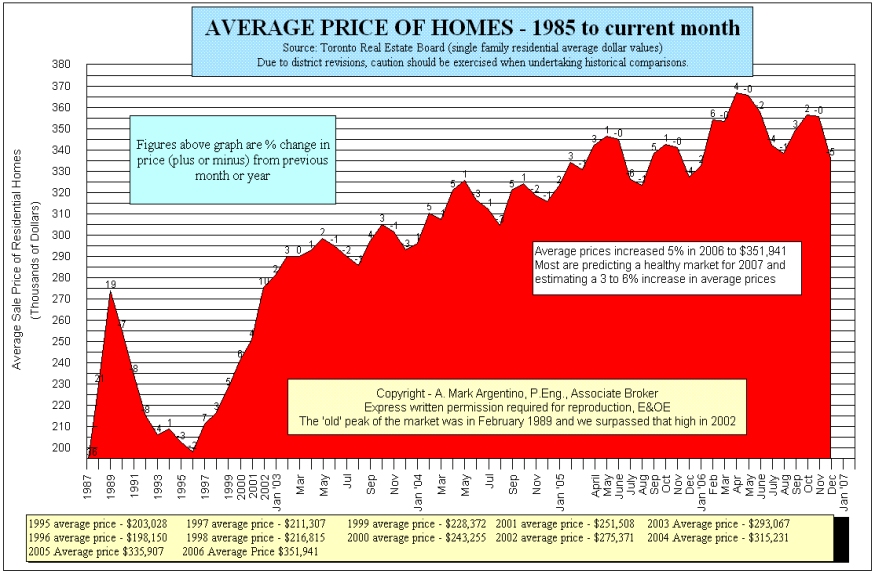 |
| Average Home Prices Toronto 1985 to 2007 |
 |
| Average Home Prices Toronto 1975 to 2009 |
Wednesday, November 17, 2010
Mortgage rates going up
Global concerns about Ireland's fragile finances and the USA's sluggish economy have caused TD Canada Trust and the Royal Bank of Canada to both raise their fixed-term mortgage rates by one-quarter of a percentage point, effective this past Wednesday.
For both banks, five-year mortgages, popular among Canadian homeowners, will rise by 0.25% to 5.44% total. Not long ago they were slashing mortgage rates in an effort to be competitive. No longer.
With signs the housing market in Canada is about to rebound (and that the housing bubble isn't going to burst immediately) they also upped rates on three-year and four-year mortgages, again by 0.25%. One-year and two-year rates will go up by 0.15%.
Rates for mortgages that have six, seven, and 10 year terms will be unchanged.
For both banks, five-year mortgages, popular among Canadian homeowners, will rise by 0.25% to 5.44% total. Not long ago they were slashing mortgage rates in an effort to be competitive. No longer.
With signs the housing market in Canada is about to rebound (and that the housing bubble isn't going to burst immediately) they also upped rates on three-year and four-year mortgages, again by 0.25%. One-year and two-year rates will go up by 0.15%.
Rates for mortgages that have six, seven, and 10 year terms will be unchanged.
Friday, November 05, 2010
Condo Buying Tips
Living in a condominium is like living in a small village, albeit you may not know the names of everyone. A condo has a board of directors made up of its residents much like a town council, and likewise it has rules, restrictions, bylaws and even fines for misbehavior such as loud, noisy parties at 4 AM on a Tuesday morning.
 Heck, there might be a condo across the street that looks EXACTLY the same as your condo, but it may be a completely different community when it comes to the way it is governed and its rules.
It pays to keep these things in mind when finding the condo unit which is right for you.
1. Condo Parking, Pets and People
You might own your own parking spot or it might rented from the condominium, and this in turn will affect whether you can sell/rent out your parking space or if you can rent/buy another parking spot for a second car.
Many condos restrict or prohibit pets such as dogs and cats, and sometimes even restrict the quieter pets like spiders, goldfish, snakes, gerbils and (heaven forbid) beekeeping.
There may also be rules restricting how many people that can live in an unit or even just occupy it temporarily in the event of a party, barbecue on the balcony, have all your yoga friends over for a vegan lunch or whatever. There might even be rules restricting you from putting a satellite dish on the outside wall. Other restrictions include when you can play musical instruments, use the pool or the party room.
2. The Condo Reserve Fund
The condo board needs to keep track of how much money is in the reserve fund and how much is needed in order for them to pay for cleaning and maintenance of the lobby, hallways, elevators, furnace, roof and parking garage. They must always be maintained and repaired or else they are liable for lawsuits for failing to fulfill contracts with condo residents. Thus the condo needs a reserve fund for emergency repairs. Often the prices of utilities, security, landscaping and snow removal go up too, so expect inflation. If there is no reserve fund, be very wary of buying.
3. Condo Management and Professionalism
 Most people on the condo board of directors lack any kind of business, legal or people skills needed to manage their building, let alone dog grooming business. They are on the board because they ran for the position and got voted in on popularity. Nothing to do with skill at all. However the are responsible for a budget that could be in the millions and must also deal with sometimes complex disputes between owners and the condo corporation. This requires a working understanding of the Provincial Condominium legislation that governs their condo. Even simple decisions such as when to turn on the air conditioning requires basic understanding of how it works and how the AC will affect unit owners in different ways, like whether they are on the south or north side of the building.
That’s why a condo needs a professional property manager. They know these things inside out and if they don't do them properly, then condo residents complain. If the condo you are buying doesn't have a property manager... then cross your fingers and hope you never run into an incompetent and belligerent elected-member of the condo board. It will be guaranteed to be headaches galore.
4. Insurance Deductible
Does your condo insurance policy have a $5,000 or $10,000 deductible? Make sure you speak to an insurance specialist about obtaining your own unit coverage to protect your belongings and any renovations made to your unit.
5. Were those renovations legal?
 If any alterations to your condo were made you should check to make sure that they got the necessary approval via the condo board. Otherwise you might have to get it approved yourself, even though its after the fact, and this can be costly. You may end up paying for further inspections and certifications by plumbers, architects or engineers, things that should have been paid for by the previous owner.
6. Do the condo residents behave?
Call it schoolyard justice and bullying if you want to, but many condo residents don't play fair. They get into feuds about the stupidest little things and the next thing you know they're both running for condo president so they can try and kick the other person out of the building. Its ridiculous.
Before you buy its recommended you knock on some doors and ask your would-be neighbours about the building and how happy they are about other neighbours. Remember to look at the minutes of the last annual meeting. Were there many items disputed? Be suspicious if they haven't had a meeting in over a year.
 7. Status Certificate
This handy little document issued by each condo shows an up to date copy of the budget, the last annual meeting, whether there are arrears / expenses, special assessments and a Reserve Fund Study. Your purchase agreement MUST be conditional on you being satisfied with the contents of this very important document. Review the document carefully with your real estate salesperson and your lawyer.
So remember these things to ask!
Parking, Pets and People
Condo Reserve Fund
Property Manager
Insurance Deductible
Legal Renovations
Condo Disputes & Annual Minutes
Status Certificate
 See Also:
The Future of Condos
Toronto Condos and Highrises
Tea Leaves for Toronto Real Estate
The Toronto Real Estate Market
The Housing & Mortgage Industry
 Heck, there might be a condo across the street that looks EXACTLY the same as your condo, but it may be a completely different community when it comes to the way it is governed and its rules.
It pays to keep these things in mind when finding the condo unit which is right for you.
1. Condo Parking, Pets and People
You might own your own parking spot or it might rented from the condominium, and this in turn will affect whether you can sell/rent out your parking space or if you can rent/buy another parking spot for a second car.
Many condos restrict or prohibit pets such as dogs and cats, and sometimes even restrict the quieter pets like spiders, goldfish, snakes, gerbils and (heaven forbid) beekeeping.
There may also be rules restricting how many people that can live in an unit or even just occupy it temporarily in the event of a party, barbecue on the balcony, have all your yoga friends over for a vegan lunch or whatever. There might even be rules restricting you from putting a satellite dish on the outside wall. Other restrictions include when you can play musical instruments, use the pool or the party room.
2. The Condo Reserve Fund
The condo board needs to keep track of how much money is in the reserve fund and how much is needed in order for them to pay for cleaning and maintenance of the lobby, hallways, elevators, furnace, roof and parking garage. They must always be maintained and repaired or else they are liable for lawsuits for failing to fulfill contracts with condo residents. Thus the condo needs a reserve fund for emergency repairs. Often the prices of utilities, security, landscaping and snow removal go up too, so expect inflation. If there is no reserve fund, be very wary of buying.
3. Condo Management and Professionalism
 Most people on the condo board of directors lack any kind of business, legal or people skills needed to manage their building, let alone dog grooming business. They are on the board because they ran for the position and got voted in on popularity. Nothing to do with skill at all. However the are responsible for a budget that could be in the millions and must also deal with sometimes complex disputes between owners and the condo corporation. This requires a working understanding of the Provincial Condominium legislation that governs their condo. Even simple decisions such as when to turn on the air conditioning requires basic understanding of how it works and how the AC will affect unit owners in different ways, like whether they are on the south or north side of the building.
That’s why a condo needs a professional property manager. They know these things inside out and if they don't do them properly, then condo residents complain. If the condo you are buying doesn't have a property manager... then cross your fingers and hope you never run into an incompetent and belligerent elected-member of the condo board. It will be guaranteed to be headaches galore.
4. Insurance Deductible
Does your condo insurance policy have a $5,000 or $10,000 deductible? Make sure you speak to an insurance specialist about obtaining your own unit coverage to protect your belongings and any renovations made to your unit.
5. Were those renovations legal?
 If any alterations to your condo were made you should check to make sure that they got the necessary approval via the condo board. Otherwise you might have to get it approved yourself, even though its after the fact, and this can be costly. You may end up paying for further inspections and certifications by plumbers, architects or engineers, things that should have been paid for by the previous owner.
6. Do the condo residents behave?
Call it schoolyard justice and bullying if you want to, but many condo residents don't play fair. They get into feuds about the stupidest little things and the next thing you know they're both running for condo president so they can try and kick the other person out of the building. Its ridiculous.
Before you buy its recommended you knock on some doors and ask your would-be neighbours about the building and how happy they are about other neighbours. Remember to look at the minutes of the last annual meeting. Were there many items disputed? Be suspicious if they haven't had a meeting in over a year.
 7. Status Certificate
This handy little document issued by each condo shows an up to date copy of the budget, the last annual meeting, whether there are arrears / expenses, special assessments and a Reserve Fund Study. Your purchase agreement MUST be conditional on you being satisfied with the contents of this very important document. Review the document carefully with your real estate salesperson and your lawyer.
So remember these things to ask!
Parking, Pets and People
Condo Reserve Fund
Property Manager
Insurance Deductible
Legal Renovations
Condo Disputes & Annual Minutes
Status Certificate
 See Also:
The Future of Condos
Toronto Condos and Highrises
Tea Leaves for Toronto Real Estate
The Toronto Real Estate Market
The Housing & Mortgage Industry
Subscribe to:
Posts (Atom)
Recently Popular Posts
-
 You don't always need to hire a plumber. There are times when you can fix things yourself. Below are 3 Common Plumbing Problems that you...
 -
 Did you enjoy last month's blog post titled 3 Common Plumbing Problems that you can Fix Yourself ? Good news! Here are three more comm...
 -
 CANADA - Looking to buy a cottage in Muskoka this summer? Good luck with that! (sarcasm) The cottage prices in the region are sky high (ie....
 -
 Did you know Toronto is one of the most expensive places to rent an apartment? In Toronto the average price of a two-bedroom apartment is $1...
 -
When it comes to buying a home the question of which neighbourhood is the best (or at least the best for you) is a question that is bound to...
-
 Kyle MacDonald is a Canadian Blogger who created a website called "One Red Paperclip". What he did was barter and trade his 1 re...
 -
 Gardening One of the ways to boost the value of your home is to plant a flower garden - especially roses, as roses are very easy to mainta...
 -
If you are looking to sell your home one of the increasingly popular things to do these days is to hire a home stager . They come into your ...
-
 I swear construction crews spend 70% of their time standing around for equipment to arrive or city staff to sign documents.
 -
 Water doesn’t always announce itself. It can seep slowly into walls, crawl spaces, or basements, leading to problems like: Mold growth that ...